
 EN
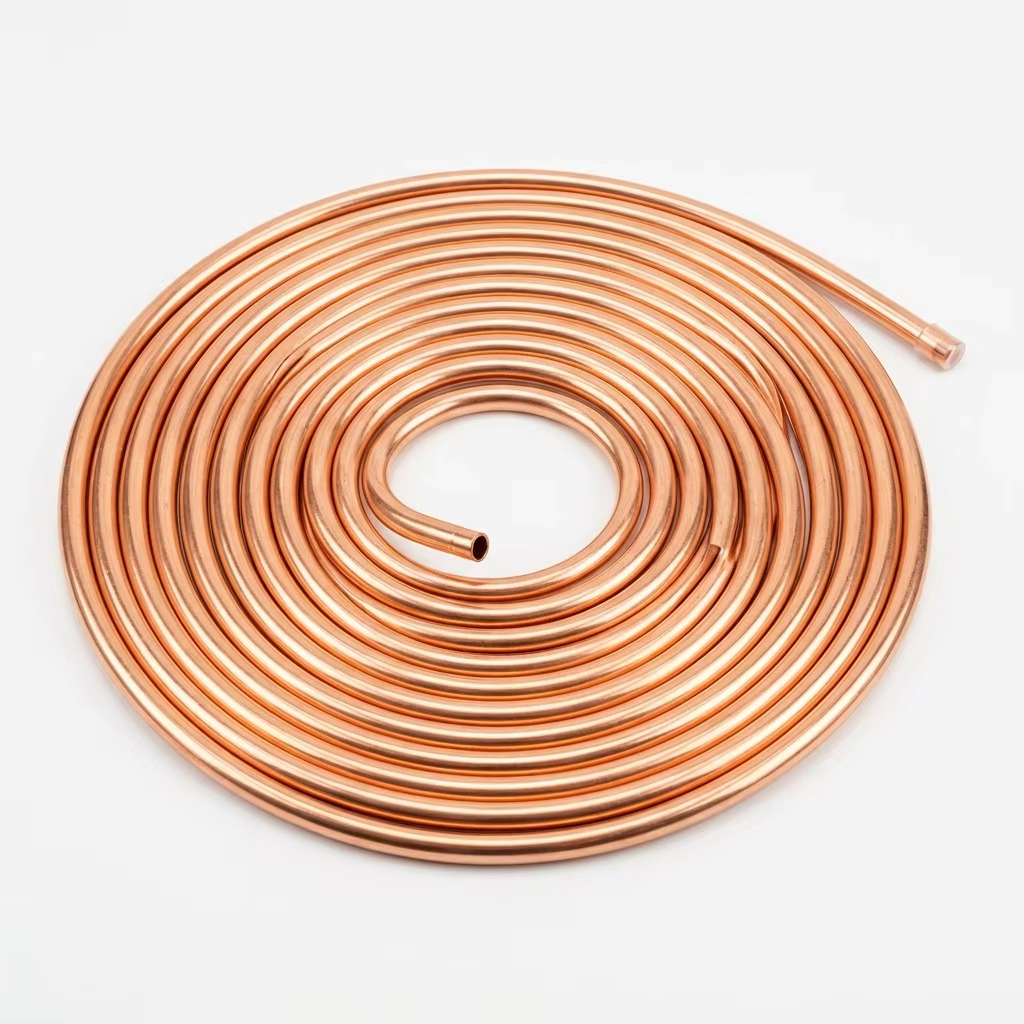
Why High Pressure Refrigerants Demand Thicker Pipe Walls
Every seasoned refrigeration technician has seen what happens when a budget-friendly line set meets a high-pressure heat pump on a blistering summer afternoon. Ten years ago, systems running on older refrigerants operated at relatively forgiving pressures, allowing installers to get away with thinner tubing walls without immediate blowouts. Today, modern HVAC equipment relies heavily on R410A, R32, and transcritical CO2 refrigerants, where operating pressures routinely climb past six hundred pounds per square inch during peak condensing cycles. Under these brutal mechanical loads, copper connecting tube thickness acts as the primary structural defense between a reliable cooling loop and a catastrophic refrigerant leak. When pipe walls fall even a fraction of a millimeter below engineering requirements, cyclic pressure spikes cause the metal to expand and contract microscopically until hairline fatigue cracks split open along the seam or flare joint.
Beyond pure burst strength, proper copper pipe wall gauge directly impacts how well a line set handles compressor vibration and harmonic resonance. High-efficiency inverter compressors ramp their rotational speeds up and down constantly, sending high-frequency mechanical pulses straight down the discharge and suction lines. Thin-walled tubing acts like a tuning fork, amplifying these vibrations into audible buzzing inside building walls while rapidly work-hardening the copper near mounting brackets. Specifying the right copper connecting tube thickness dampens those harmonic waves, prevents flare nuts from backing off under vibration, and shields contractors from expensive warranty callbacks that wipe out project installation profits.
Decoding ASTM Standards and Gauge Classifications for HVAC
Walking through a wholesale supply house or reviewing international factory spec sheets requires a clear grasp of how tubing standards translate across borders. In North America, engineers categorize hvac refrigerant tubing under ASTM B280 standards using Type K, Type L, and Type M designations, whereas European and Asian projects typically specify metric wall thicknesses governed by EN 12735 or JIS H3300 standards. For standard air conditioning and refrigeration work, Type L copper—or its metric equivalent of 0.8mm to 1.0mm wall thickness depending on outer diameter—serves as the industry baseline. Cheaper consumer-grade split system kits sometimes sneak in 0.5mm or 0.6mm walls to shave a few dollars off shipping weight, but those ultra-thin walls violate commercial mechanical codes and fail rapidly under pressure testing.
Material purity works hand in hand with copper connecting tube thickness to guarantee long-term structural integrity. High-grade refrigeration tubing is extruded from C12200 phosphorus-deoxidized copper, containing at least 99.9 percent pure copper to prevent hydrogen embrittlement during high-temperature silver brazing. When evaluating ac line set durability, procurement teams must look at both the temper of the metal—whether it is soft annealed coil tubing or hard drawn straight lengths—and the concentricity of the wall. If an extrusion die wears out on a poorly managed factory floor, one side of the tube wall ends up thick while the opposite side thins out dangerously. True compliance with ASTM B280 means every millimeter of the circumference maintains uniform refrigerant line pressure rating margins from end to end.
Preventing Kinks and Flare Splits During Field Installation
The real test of copper connecting tube thickness happens out on the job site when an installer has to snake an insulated line set through tight ceiling joists and sharp brickwork corners. When bending soft annealed hvac refrigerant tubing by hand or with a lever bender, the outer radius of the bend stretches and thins out while the inner radius compresses. If the starting copper pipe wall gauge is only 0.5mm, even a gentle ninety-degree bend will cause the inner wall to buckle inward, creating a nasty kink that chokes refrigerant mass flow and starves the evaporator coil. Moving up to a proper 0.8mm or 1.0mm wall provides the structural backbone needed to maintain a perfectly round internal bore around tight architectural turns without collapsing.
Flaring connections for mini-split and VRF indoor units puts even more extreme localized stress on the metal. When a technician drives an eccentric flaring cone into the end of a cut tube, the copper is stretched outward by nearly thirty percent of its original diameter. Thin tubing simply lacks the cross-sectional volume to stretch that far; it tears at the outer rim or leaves a paper-thin flare face that crushes flat the moment a torque wrench tightens the brass flare nut. A robust copper connecting tube thickness ensures the flared bell remains thick enough to seat firmly against the forty-five-degree brass fitting cone, forming a gas-tight metal-to-metal seal that holds vacuum down below five hundred microns on the very first pull.
Real World Cost Analysis of Thin Versus Standard Gauge Tubing
To see how wall specs affect the bottom line, consider a multi-family apartment complex project in Phoenix, Arizona, where a mechanical contractor installed two hundred and forty ductless heat pump zones. Looking to trim upfront material expenses by twelve percent, the purchasing department sourced budget pre-insulated line sets featuring a 0.6mm wall on the half-inch suction lines instead of the specified 0.8mm gauge. During initial nitrogen pressure testing at five hundred psi, nineteen flare joints split open, and seven concealed wall bends kinked badly enough to require tearing open finished drywall. Within the first eighteen months of operation under intense desert heat, another thirty-two units lost their refrigerant charge due to micro-cracking near the outdoor condensing unit service valves.
By the time the contractor paid for emergency technician labor, drywall patching, replacement R410A refrigerant, and replacement hvac refrigerant tubing, the warranty repair bill topped sixty-four thousand dollars—more than ten times the tiny savings gained from buying undersized pipe. Upgrading copper connecting tube thickness up front is the cheapest insurance policy in the cooling industry. Prioritizing ac line set durability protects compressor windings from running hot on low charge, maintains peak seasonal energy efficiency ratios, and preserves a contractor's hard-earned reputation with commercial property developers.
Sourcing Precision Extruded Copper Tubing for Global Projects
Securing consistent refrigerant line pressure rating performance across thousands of installations requires partnering with an upstream manufacturer that controls every step of the metallurgical and forming process. Distributors and OEM equipment builders cannot afford batch-to-batch variations where one pallet of coils flares smoothly and the next pallet splits under the flaring tool. Precision eddy-current testing, ultrasonic wall gauge verification, and bright annealing furnaces filled with protective nitrogen gas are mandatory production steps to ensure every single coil meets exact international mechanical tolerances.
This level of engineering rigor is exactly why global HVAC wholesalers and project contractors rely on Eletek for their core piping and system hardware needs. Operating advanced manufacturing facilities in Suzhou and Jinan, Eletek produces and supplies high-purity insulated copper connecting tubes, ac copper fittings, brass flare nuts, and complete line-set installation kits built strictly to international ASTM and EN standards. Whether a project calls for custom-length twin insulated coils with heavy-duty PE foam or specialized copper manifolds and filter driers, Eletek maintains tight dimensional control over copper pipe wall gauge across every production run. By consolidating ac line set durability and precision manufacturing under one roof, Eletek helps distributors eliminate field failures and deliver rock-solid cooling infrastructure worldwide.

