Product brief description
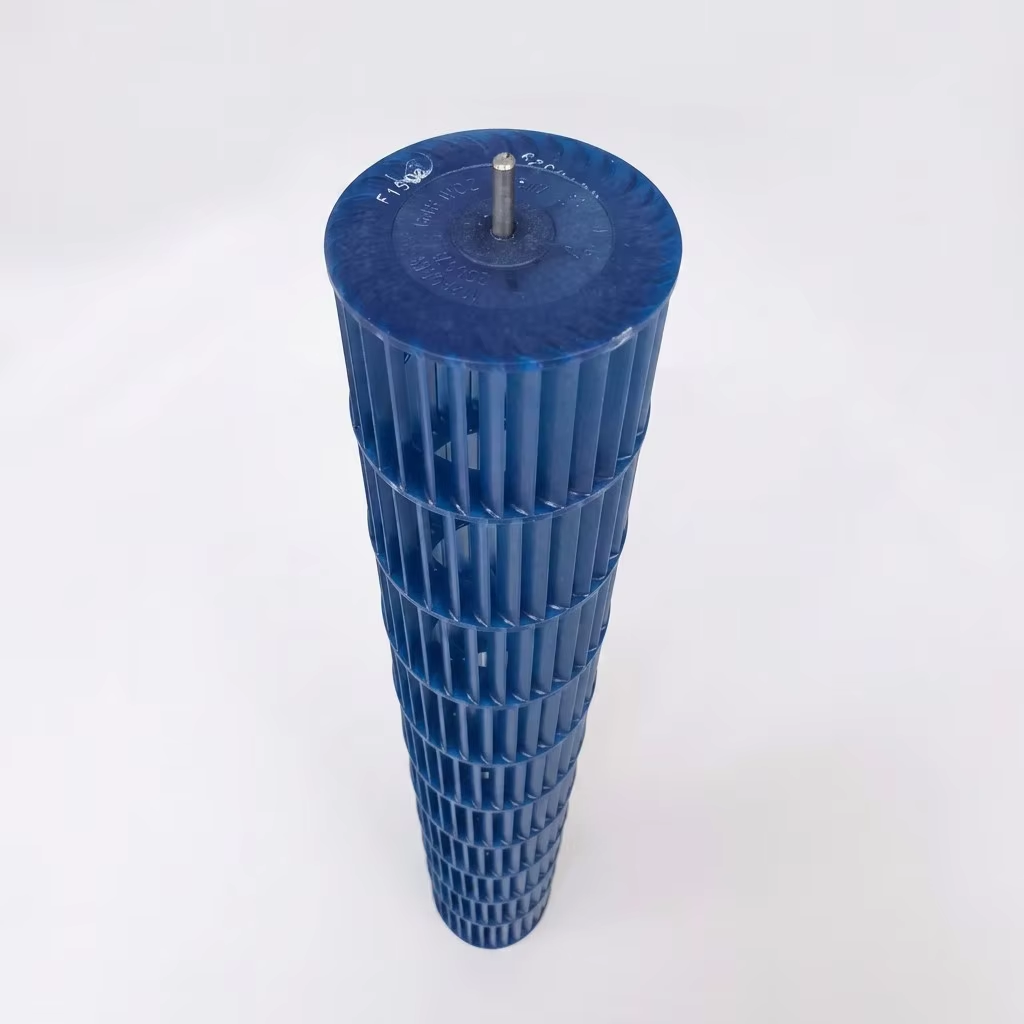
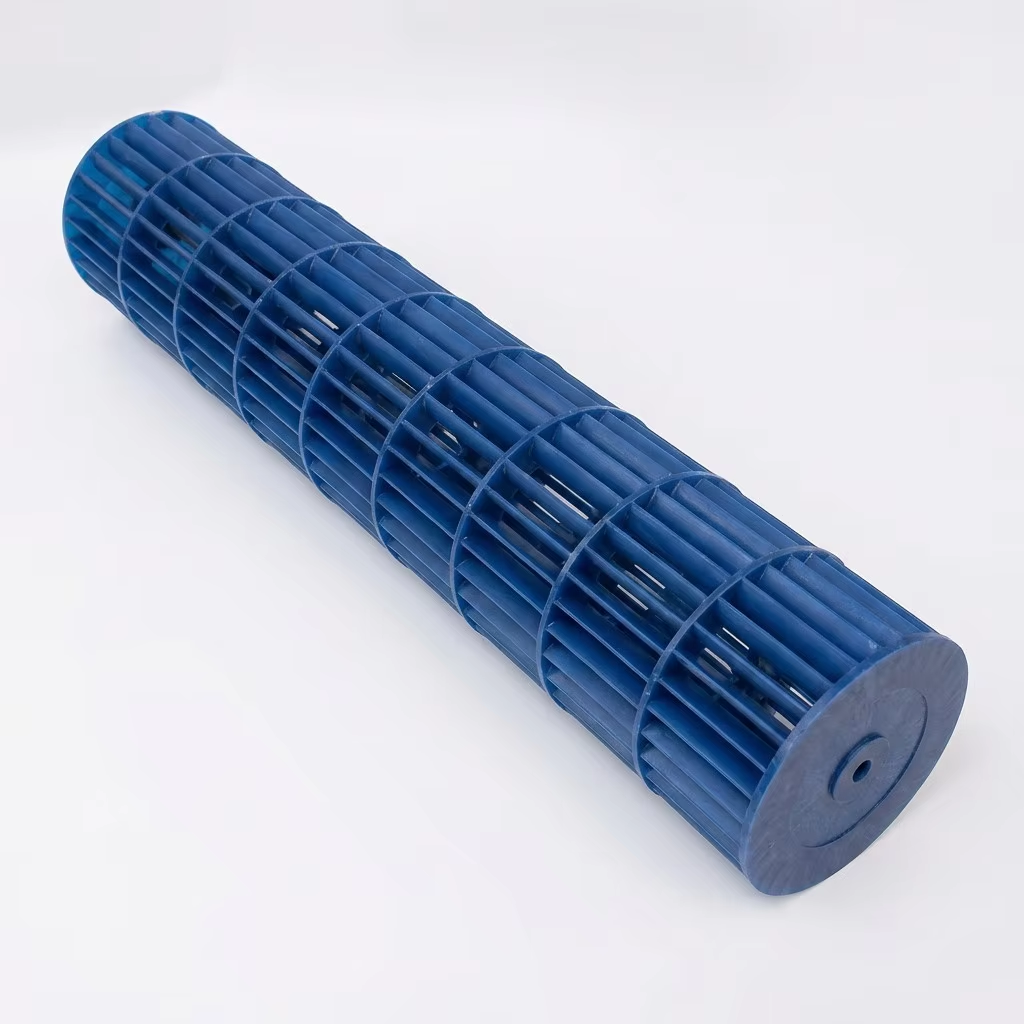
The CrossFlo CF-Series is a precision injection-molded cross flow (tangential) fan impeller designed for applications requiring wide, uniform, low-turbulence airflow. Unlike axial fans that push air perpendicular to the blade plane, the cross flow design draws air in across the impeller's length and discharges it in a broad, even sheet — ideal for slim-profile HVAC equipment where space is limited and airflow uniformity is critical. Manufactured from high-strength engineering-grade ABS in vibrant royal blue, the CF-Series features a multi-tier stacked blade configuration separated by rigid stabilizing rings, with a centered metal shaft for direct motor coupling. Available in standard lengths and diameters for universal compatibility with major AC brands and OEM designs.
Product detailed description
The Physics of Cross Flow
Cross flow fans operate on a fundamentally different principle than axial or centrifugal designs. Air enters the impeller along its full axial length, passes through the blade cascade twice — once inward and once outward — and exits as a uniform rectangular sheet. This double-pass flow pattern, governed by an eccentric vortex that forms inside the impeller, produces a remarkably even velocity profile across the entire discharge width.
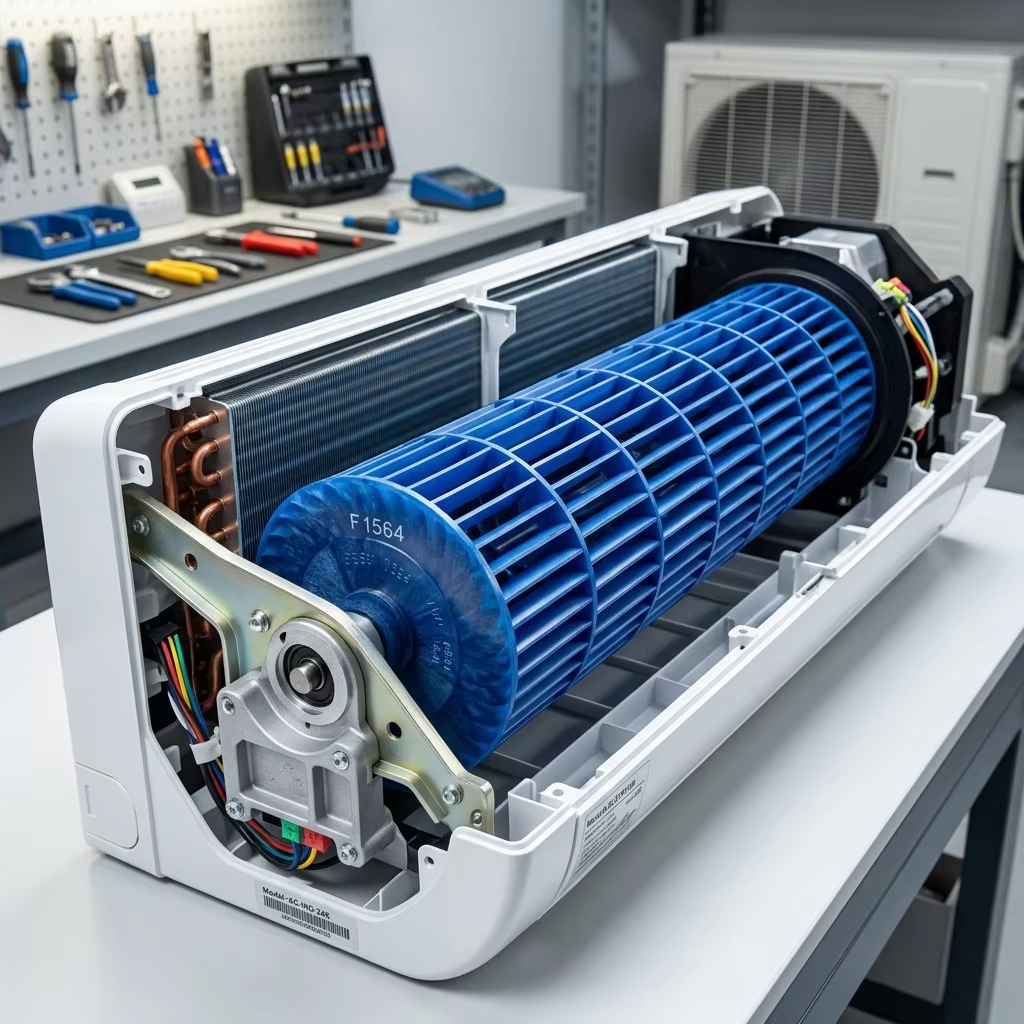
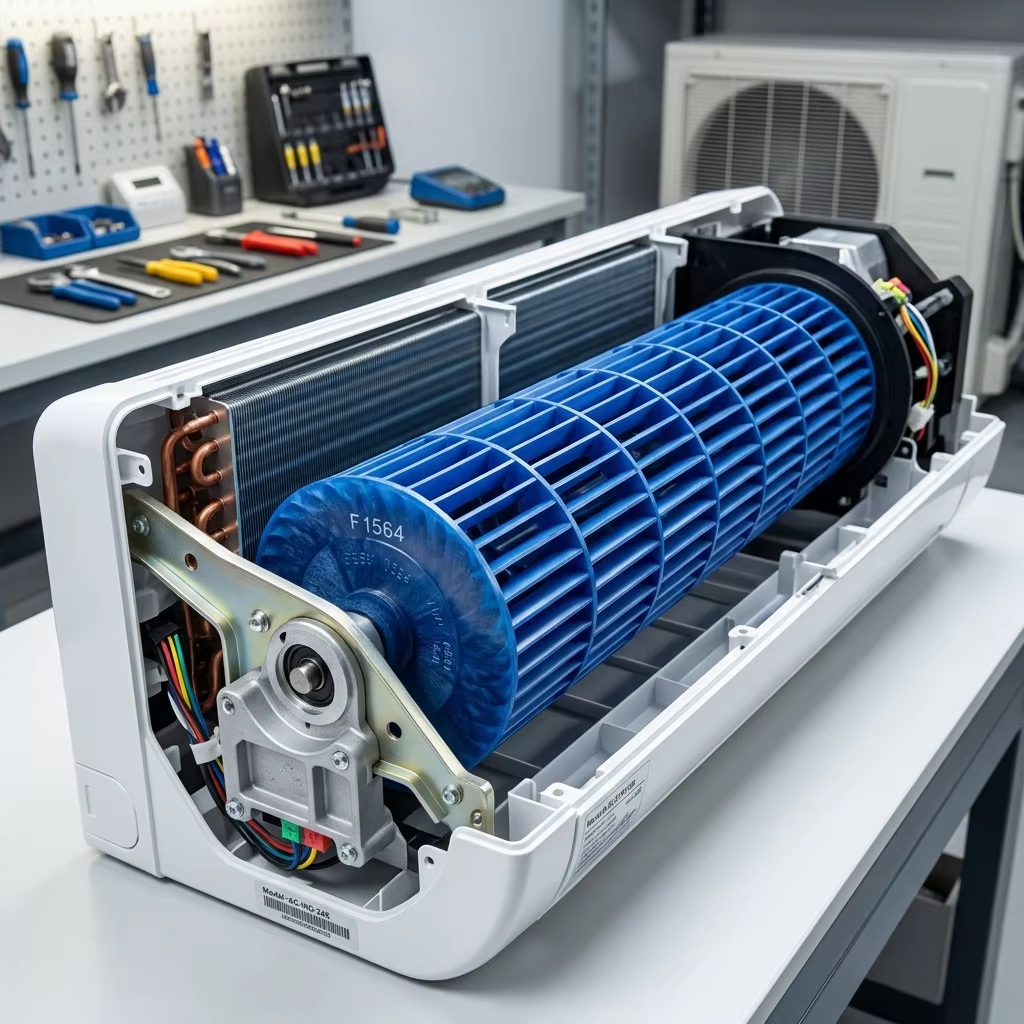
The practical consequence is profound: a single cross flow impeller can replace a row of multiple axial fans in applications demanding wide-area coverage. This is why virtually every wall-mounted split air conditioner indoor unit, every commercial air curtain, and every fan coil unit relies on a cross flow fan as its primary air-moving component.
Construction and Materials
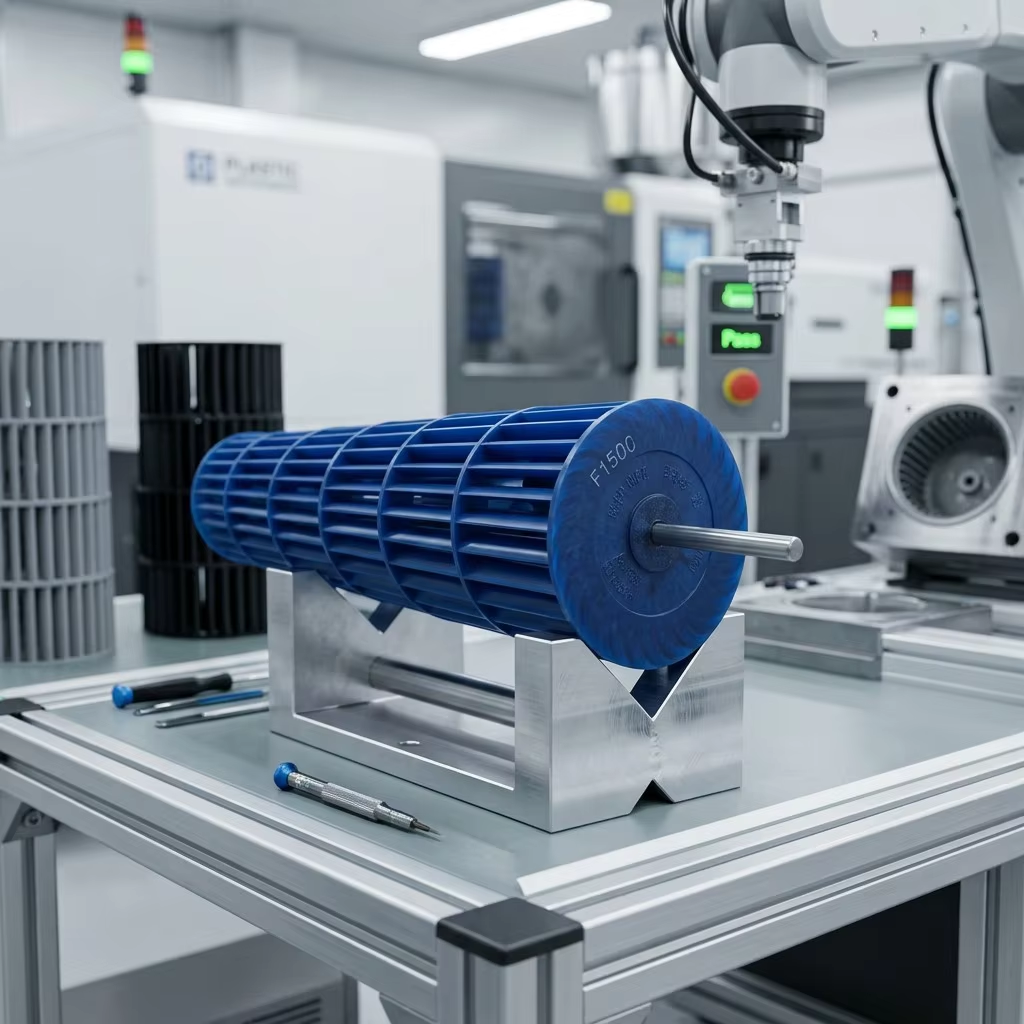
The CF-Series impeller body is injection-molded from high-impact ABS (Acrylonitrile Butadiene Styrene), selected for its optimal balance of rigidity, impact resistance, dimensional stability, and cost-effectiveness. The royal blue color is molded-in throughout the material — not surface-painted — ensuring that color consistency is maintained even after years of operation and cleaning.
The impeller structure consists of multiple identical blade tiers stacked along the axial length. Each tier contains a circular array of thin, forward-curved blades precisely angled to optimize the double-pass airflow pattern. Between each tier, a solid horizontal stabilizing ring provides radial rigidity, preventing blade deflection under centrifugal load and maintaining the tight tip clearance essential for aerodynamic efficiency.
At the ends, solid end caps with molded-in bearing seats and shaft interfaces ensure concentric rotation. The top end cap features a precision-molded bore that accepts the metal drive shaft, which is press-fitted and secured to transfer motor torque without slippage. The shaft itself is manufactured from chrome-plated carbon steel for corrosion resistance and dimensional accuracy.
Aerodynamic Performance
Cross flow impeller performance is defined by three parameters: airflow volume (CFM or m³/h), discharge velocity uniformity, and noise signature. The CF-Series is optimized for all three.
Airflow uniformity is achieved through precise blade geometry and tier spacing. Each blade's entrance and exit angles are computationally optimized using CFD (Computational Fluid Dynamics) to ensure that the internal eccentric vortex remains stable across the operating RPM range. An unstable vortex causes pulsing airflow and tonal noise — a common defect in budget impellers that the CF-Series design eliminates.
Low noise operation is inherent to the cross flow design. Because the impeller rotates at relatively low RPM compared to axial fans of equivalent airflow, blade-pass frequency noise is lower and less objectionable. The CF-Series further reduces noise through precision molding tolerances — blade-to-blade spacing variation is held within ±0.05mm, eliminating the periodic imbalance that generates harmonic noise components.
Applications
The CF-Series serves as a direct replacement or OEM component in:
- Split air conditioner indoor units: wall-mounted, floor-standing, and cassette types from 9,000 to 36,000 BTU/h
- Air curtains: commercial entrance air barriers for retail stores, restaurants, and cold storage facilities
- Fan coil units (FCU): hotel and office building HVAC terminal units
- Air purifiers: residential and commercial units requiring wide, low-velocity air distribution
- Electronic equipment cooling: server racks, telecom cabinets, and industrial control panels needing uniform cross-ventilation
- Electric fireplaces and heaters: flame-effect units where silent operation and wide heat distribution are essential
- Automotive HVAC: bus and RV air conditioning systems
Quality Assurance
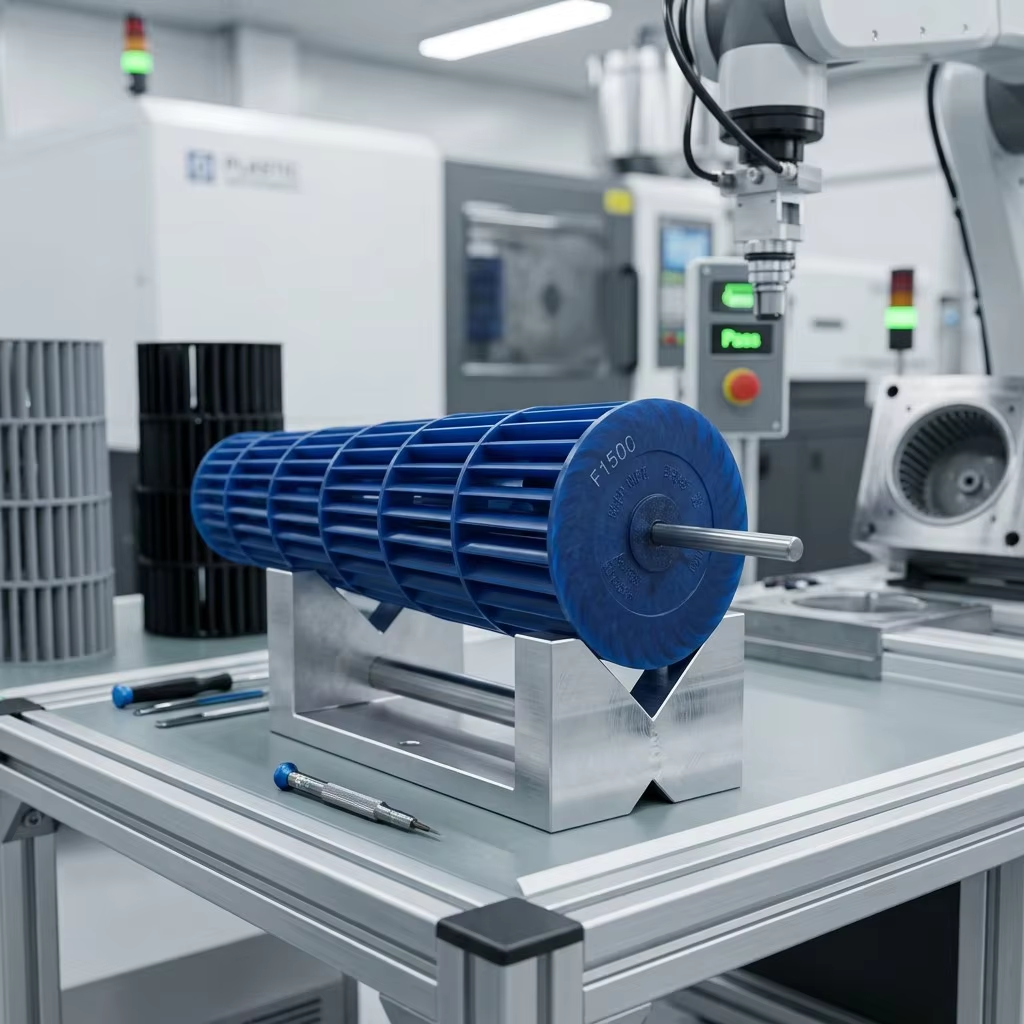
Every CF-Series impeller passes a three-stage quality gate:
- Dimensional verification: Key dimensions — overall length, diameter, shaft concentricity, and blade spacing — are checked against CAD nominal using digital gauges and CMM where specified.
- Dynamic balance: Each impeller is dynamically balanced on a dedicated balancing machine to ISO 1940-1 Grade G6.3 or better. Balance correction is achieved by material removal at the end caps, preserving blade integrity.
-
Runout check: Assembled impeller runout at the shaft and end cap faces is verified to ensure true rotation when coupled to the drive motor.Balanced impellers receive a batch traceability code, enabling full backward traceability to the molding production lot, material batch, and inspection records.
Installation Guidelines
The cross flow impeller is a direct-drop replacement in most split AC indoor units. Installation steps:
- Remove the indoor unit front cover and the impeller retaining bracket
- Slide the old impeller off the motor shaft (note the shaft flat orientation)
- Clean the motor shaft with isopropyl alcohol to remove any grease or debris
- Slide the new CF-Series impeller onto the shaft, aligning the shaft flat with the set screw
- Tighten the set screw to the specified torque (typically 2.5–3.0 N·m)
- Verify free rotation by hand before reinstalling the bracket, then replace the front cover
-
Always disconnect power at the circuit breaker before servicing any HVAC equipment.
Product Specifications
meter |
Specification |
Product Series |
CrossFlo CF-Series |
Impeller Type |
Cross Flow / Tangential Fan |
Blade Configuration |
Multi-Tier, Forward-Curved |
Number of Tiers |
8–14 (varies by length) |
Material |
High-Impact ABS (Acrylonitrile Butadiene Styrene) |
Material Color |
Royal Blue (Molded-In, Not Painted) |
Shaft Material |
Chrome-Plated Carbon Steel |
Available Diameters |
90 / 95 / 100 / 102 / 105 / 108 / 110 mm |
Available Lengths |
400–1200 mm (custom lengths available) |
Shaft Diameter |
8 / 10 / 12 mm (application-dependent) |
Rotation Direction |
Clockwise (CW) or Counter-Clockwise (CCW) |
Max Operating RPM |
1,500 RPM |
Balance Grade |
ISO 1940-1 Grade G6.3 |
Operating Temperature |
-10°C to +70°C (14°F to 158°F) |
Noise Level |
≤ 42 dB(A) at rated speed |
Molding Process |
Precision Injection Molding |
Compatible AC Brands |
Universal fit for major brands (Gree, Midea, Daikin, Mitsubishi, Panasonic, LG, Samsung, Carrier, Trane, Haier, Hisense, etc.) |
Quality Certifications |
ISO 9001, CE, RoHS |
Warranty |
2 Years |
FAQ
Q1: How do I identify the correct cross flow fan for my air conditioner?
You need three measurements: (1) impeller overall length from end cap to end cap,
(2) impeller outer diameter, and (3) motor shaft diameter. The model number printed on your existing impeller's end cap (e.g., "F1562" or similar) is the fastest way to identify the correct replacement. Send us these details or a clear photo of the markings, and we will match the correct CF-Series model.
Q2: Are your impellers compatible with all AC brands?
The CF-Series is designed as a universal replacement compatible with the vast majority of split AC indoor units from major brands including Gree, Midea, Daikin, Mitsubishi Electric, Panasonic, LG, Samsung, Carrier, Trane, Haier, Hisense, Toshiba, Fujitsu, and Hitachi. As long as the length, diameter, and shaft dimensions match, the impeller will function correctly. We recommend confirming all three dimensions before ordering.
Q3: What causes cross flow fan noise, and how does the CF-Series prevent it?
Three factors cause cross flow fan noise: (1) imbalance — corrected by our dynamic balancing process, (2) blade deformation — prevented by the CF-Series multi-ring stabilizing structure, and (3) unstable internal vortex — eliminated through our CFD-optimized blade geometry. Additionally, the injection-molded ABS construction inherently damps vibration better than metal impellers, contributing to quieter operation.
Q4: What is the difference between CW and CCW rotation?
Clockwise (CW) and counter-clockwise (CCW) refer to the impeller's rotation direction when viewed from the shaft end. The direction is determined by the AC unit's motor and control board. Installing a CW impeller in a CCW application (or vice versa) will result in drastically reduced airflow and potential motor overheating. Always verify the rotation direction of your existing impeller before ordering. If uncertain, send us a short video of the fan running and we will confirm the correct orientation.
Q5: Can I order custom lengths or diameters?
Yes. While we stock the most common sizes, our injection molding capability allows us to produce custom lengths and diameters for OEM customers. Custom tooling may be required for non-standard diameters, with typical lead times of 4–6 weeks for tooling development plus 2–3 weeks for production. Minimum order quantities apply for custom specifications.
Q6: What is your MOQ and pricing structure?
Standard MOQ: 50 units per size for wholesale orders. Sample orders of 1–5 units are available at sample pricing for testing and fitment verification. Volume tier discounts apply at 500, 1,000, and 5,000+ units. Contact our sales team with your expected annual volume for a tailored pricing proposal.



 ONLINE

 EN
EN